ok so amelie is my favourite film. i think it’s because watching it makes me want to pay attention to my own life for a bit. the little things count in this film: a good coffee, cracking crème brûlée, seeing somebody smile because you did something kind and they never even found out it was you.
it makes ordinary life feel like it has secret corners. not everything has to be a big dramatic moment to matter. sometimes it’s just the way a room looks in the afternoon, or finding one small thing that makes a rubbish day feel a bit less rubbish.
the colours help create that feeling. reds, greens and yellows are everywhere, but it doesn’t feel like someone just stuck a filter on paris. the rooms, clothes, cafés and streets all seem to belong to the same slightly heightened world. cinematographer bruno delbonnel said he and jean-pierre jeunet wanted a hazy, saturated look, and kept working with a fuller range of colours. his interview with Film and Digital Times has a great bit about how they found the look.
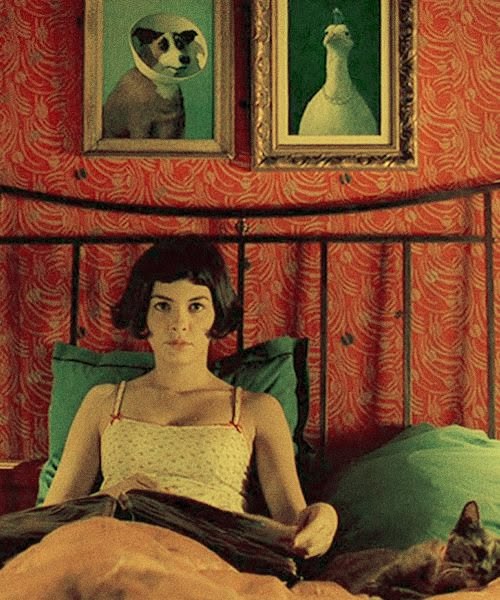
the frame is part of her inner world
this bedroom shot is so pretty, but there’s something lonely about it too. amelie is in the middle of the bed, with all that red wallpaper and the headboard boxing her in. the green pillows look soft and safe, but she still feels miles away from everybody. i like that the film lets both things be true at once: her world is lovely to look at, and she’s still on her own in it.
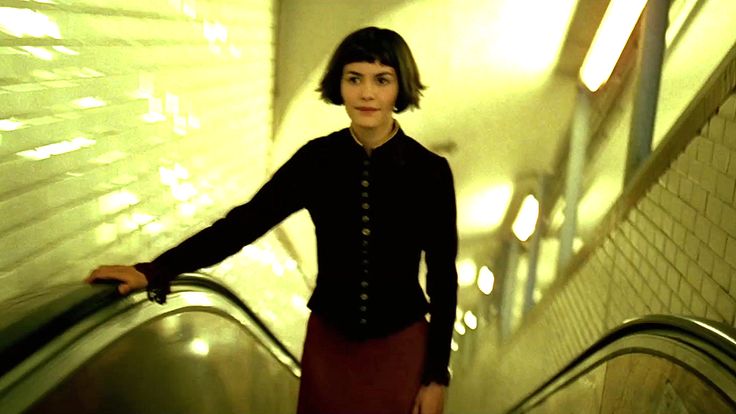
the escalator shot has the same sort of feeling, just out in public. all those bright lines run past her, and she’s there in the middle of this big glowing space, watching the world go by. the film often keeps the places around its characters in the frame. delbonnel talked about choosing wide lenses to show the buildings that make montmartre feel like montmartre. this Los Angeles Times interview with him has some good context on how they looked for the locations.
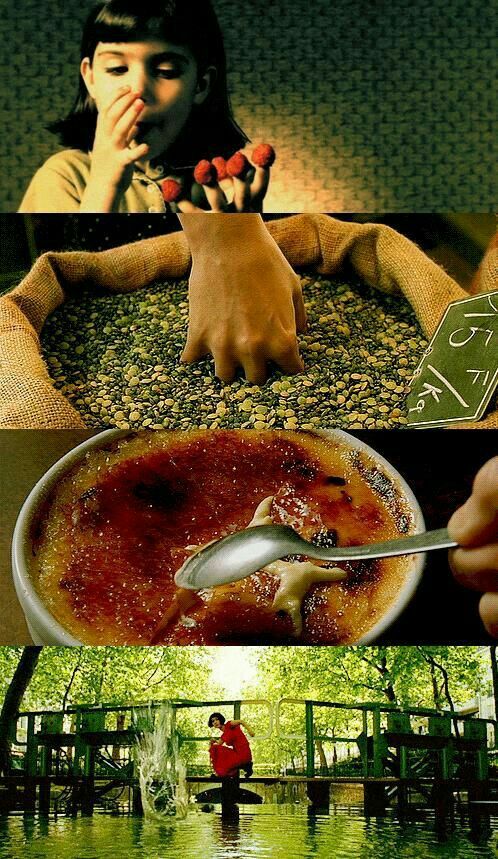
little sensations get the close-up
then there are all the close-ups of the things she loves: raspberries, coffee beans, crème brûlée. i get why those scenes stick with people. they slow down just long enough for you to imagine the texture, the sound, the taste. the film makes enjoying something small feel like a proper reason to be alive for a second.
but it isn’t saying that a few nice details fix everything. amelie is good at helping people from behind the scenes, and that’s sweet, but it also lets her keep her distance. i think that feels true to life. you can care about people and still find it scary to let them see you properly.
i think that’s why it’s my favourite. it makes me feel warmer toward ordinary life, but it doesn’t pretend loneliness disappears just because the world looks nice. it’s about noticing people, being kind in small ways, and eventually letting them notice you back. and apparently cracking a dessert can be cinema.